
Views: 0 Author: Site Editor Publish Time: 2026-07-29 Origin: Site


Industrial environments subject to extreme temperature fluctuations face severe operational impacts from nuisance tripping and premature equipment failure. Standard thermal and thermal-magnetic circuit breakers rely heavily on ambient temperature to operate. This forces engineers to perform complex derating calculations and risks unpredictable protection in harsh climates. When a control panel sits in direct sunlight or next to a blast furnace, a thermal breaker might trip well below its rated current, shutting down critical processes. Hydraulic-magnetic technology provides the definitive solution for temperature-stable circuit protection. By relying on magnetic flux rather than thermal expansion, these devices maintain their exact trip points regardless of external heat or cold. We will evaluate the top hydraulic magnetic circuit breaker applications and specification criteria for industrial engineers and procurement teams looking to eliminate heat-induced failures and stabilize their power distribution networks.
Temperature Independence: Hydraulic-magnetic circuit breakers (HMCBs) carry 100% rated current regardless of ambient temperature, eliminating the need for thermal derating.
Precision Inrush Handling: Customizable fluid viscosities allow for precise time-delay curves, preventing nuisance trips from high-inrush industrial motors and transformers.
Safety-Trip-Free Design: HMCBs feature a positive trip-free mechanism, ensuring contacts open during an overload or short circuit even if the operating handle is physically held in the "ON" position.
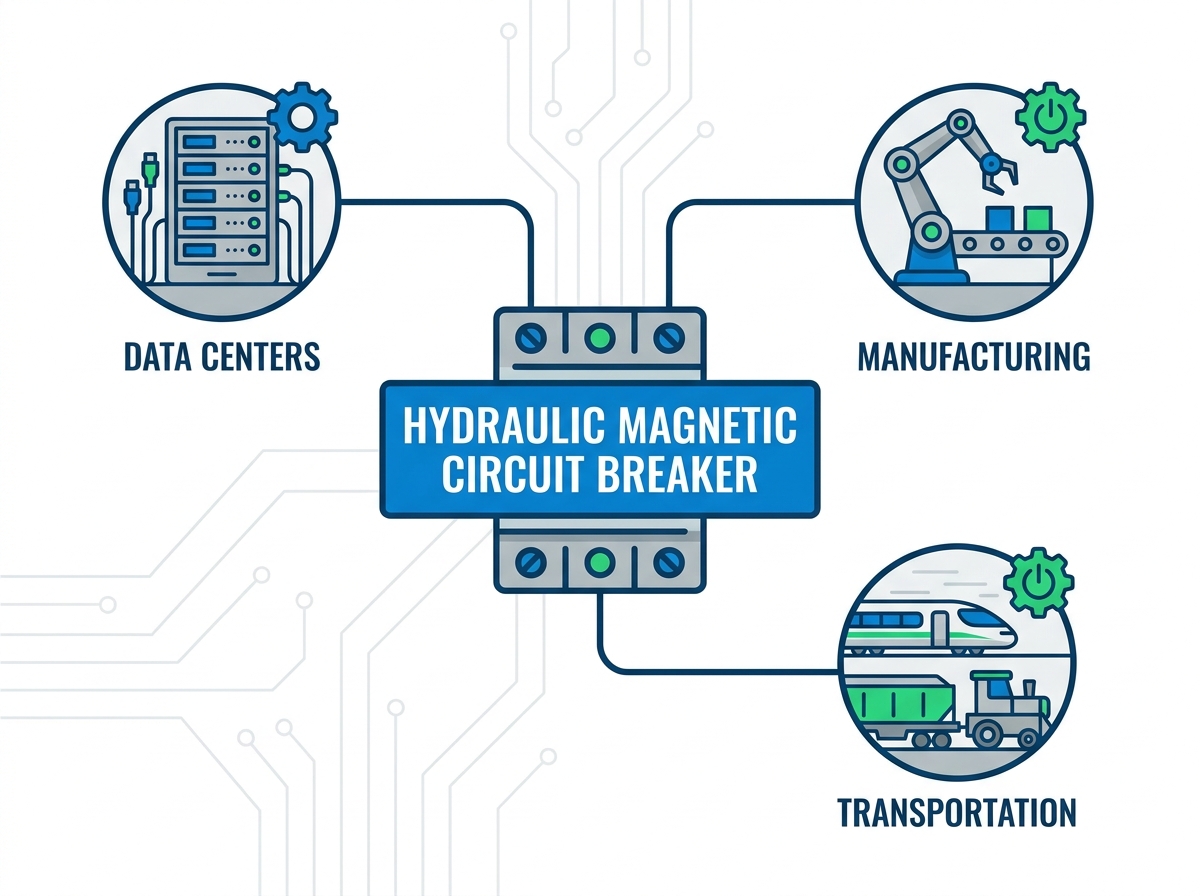
High-Reliability Sectors: The most critical hydraulic magnetic circuit breaker applications include marine, telecom, rail, emergency power, and heavy manufacturing where environmental volatility is guaranteed.
Orientation and Magnetic Constraints: Unlike thermal breakers, HMCBs are gravity-sensitive and susceptible to proximity-induced magnetic interference, requiring deliberate panel layout planning.
Table of Contents
Hydraulic-magnetic circuit breakers operate on a fundamentally different mechanical principle than standard breakers. They rely on magnetic flux generated by load current passing through a series-connected solenoid coil. They do not use the heating and bending of a bimetallic strip to trigger the trip mechanism. This mechanical difference provides a massive operational advantage in the field. You get consistent, unwavering trip points from -40°C to +85°C. You completely avoid the derating penalties associated with thermal-magnetic breakers.
If you install a 50-amp thermal breaker in a boiler room where ambient temperatures reach 50°C, that breaker might trip at 35 amps. You would have to oversize the breaker and the wiring to compensate, which compromises short-circuit protection. HMCBs eliminate this problem. A 50-amp HMCB holds 50 amps at 85°C just as it does at 20°C. This directly impacts panel design. Engineers can achieve much higher density packaging in control panels. You no longer need forced-air cooling, ventilation louvers, or strategic spacing requirements just to manage breaker heat dissipation.
The secret to an HMCB's performance lies in a hermetically sealed dashpot tube located inside the solenoid coil. This tube contains a spring-biased iron core and a specific volume of silicone fluid. When an overload occurs, the magnetic field pulls the iron core through the fluid toward the pole piece. Varying the fluid viscosity dictates the exact time delay under overload conditions. Manufacturers offer Short, Medium, Long, and specialized Motor-Start delays by simply changing the fluid properties during assembly.
Thermal breakers offer very limited flexibility for managing transient spikes. You often have to dangerously oversize a thermal breaker to handle the initial inrush of a large induction motor. HMCBs let you match the delay curve exactly to your load profile. The core moves slowly through thick fluid for a long delay, ignoring a 10-second motor startup spike. However, if a massive short circuit occurs, the magnetic flux is so strong that it bypasses the fluid delay entirely, pulling the armature instantly to clear the fault.
Industrial safety standards demand foolproof protection. HMCBs utilize a specialized mechanical linkage design that decouples the manual operating handle from the internal contacts during a fault condition. Overload protection remains active and absolute. It protects personnel and capital equipment even during manual override attempts.
If an operator tries to force a tripped breaker closed while a dead short still exists on the line, the internal contacts will still snap open. The handle might be physically taped or held in the "ON" position, but the internal mechanism trips free of the handle. This ensures strict safety compliance and prevents catastrophic equipment fires caused by operator error.
HMCBs can be precisely calibrated for various electrical systems at the factory. You can specify them for DC battery banks, standard 50/60 Hz AC grid power, or specialized 400 Hz high-frequency applications. Aerospace, naval, and military systems frequently use 400 Hz power to reduce the physical size and weight of transformers and motors. Standard thermal breakers often struggle with high-frequency eddy currents, but HMCBs handle them easily.
Dual-frequency or universal ratings on a single device offer a distinct advantage for equipment builders. A machine builder can install the same universal HMCB in a control panel destined for a 60 Hz facility in Texas or a 50 Hz facility in Germany. This drastically reduces inventory SKUs for global equipment manufacturers. You simplify supply chains, reduce warehouse overhead, and maintain precise protection across all export models.
Application | Primary Environmental Stress | Key HMCB Advantage |
|---|---|---|
Telecom & Data Center PDUs | High ambient heat (hot aisle) | No thermal derating |
Marine & Offshore Drilling | Corrosion, salt spray, heat | Hermetically sealed dashpot |
Railway & Rolling Stock | Shock, vibration, weather | Vibration-resistant mechanisms |
Heavy Motor Control Centers (MCC) | High-inrush currents | Tailored motor-start curves |
Renewable Energy (Solar/BESS) | High DC arc fault risk | Advanced DC arc extinguishing |
Emergency Generators & Gensets | Continuous engine vibration | Decoupled thermal-vibe design |
Precision Medical Imaging | Magnetic/RF interference | Ultra-precise trip thresholds |
High-density server racks and telecom rectifiers generate intense, concentrated heat. Remote 5G cell towers face direct solar radiation and extreme weather. These environments demand uninterrupted power supply protection. Facility managers have zero tolerance for heat-induced nuisance tripping in densely packed Power Distribution Units (PDUs). When a server rack exhausts 100°F air directly onto a PDU, thermal breakers will prematurely trip, taking down critical network infrastructure.
HMCBs provide precise current monitoring without heat sensitivity. They retain 100% of their nameplate rating in hot-aisle environments. Compact modular designs also optimize valuable rack space. You can stack dozens of HMCBs side-by-side in a 1U or 2U rackmount PDU without worrying about cumulative heat buildup degrading their performance.

Shipboard generator panels and thruster controls operate in brutal, unforgiving conditions. Navigation systems and offshore rig motor controls face extreme humidity, constant salt spray, and heavy galvanic corrosion. They also endure massive temperature swings. The ambient heat inside a ship's engine room contrasts sharply with the arctic external conditions on the main deck.
Thermal breakers fail rapidly in these environments. The bimetallic strips corrode, and the extreme engine room heat causes constant false trips. HMCBs solve this. The hermetically sealed dashpots prevent internal corrosion from salt-laden air. The magnetic operation remains completely stable regardless of engine room ambient heat. A 100A breaker protecting a bilge pump will hold 100A whether the ship is in the freezing Bering Sea or the sweltering Persian Gulf.
Traction control networks and passenger HVAC systems require rugged, fail-safe protection. Signaling equipment and braking systems in locomotives endure constant physical movement. They require high tolerance for continuous shock, heavy vibration, and sudden impacts. Reliable operation across diverse geographic climates is mandatory for transit authorities.
Standard breakers can physically rattle apart or trip falsely when a train hits a rough section of track. HMCBs utilize specialized shock-resistant armature designs and heavy-duty counterbalances to prevent false trips during transit. You get consistent electrical performance from sub-zero winter commuter lines in Chicago to high-heat desert freight routes in Arizona.
Industrial conveyors, rock crushers, and high-capacity fluid pumps draw massive power on startup. Stamping presses and heavy-duty compressors create similar electrical challenges. Managing massive inrush currents during inductive motor startup is critical for plant stability. These transient currents often hit 8x to 12x the full load current for several seconds.
You must handle this massive spike without compromising the tight short-circuit protection required for the steady-state run mode. HMCBs utilize specific high-inrush time-delay curves. The thick silicone fluid in the dashpot ignores the initial 10-second startup spike. Once the motor reaches running speed and the current drops, the breaker provides highly accurate protection against sustained, lower-level overloads that would eventually burn out the motor windings.
Solar combiner boxes and wind turbine nacelles operate outdoors, fully exposed to the elements. Battery Energy Storage Systems (BESS) handle massive power transfers during peak grid demand. These systems must handle high DC voltages and extreme outdoor temperature variations. They often lack enclosure-level cooling systems due to remote installation locations.
Breaking a high-voltage DC circuit is notoriously difficult because DC current does not cross zero volts like AC current. It sustains a continuous arc. HMCBs offer superior DC arc-extinguishing capabilities. They use integrated permanent magnets to physically blow the electrical arc into specialized arc chutes, stretching and cooling the plasma until it extinguishes. Furthermore, they eliminate the need for thermal derating in hot desert solar farms, allowing engineers to size cables and breakers exactly to the panel output.

Standby commercial generators and mobile military power units must start reliably the moment grid power fails. Construction site gensets face harsh field conditions, dust, and abuse. When designing a generator control panel, you must mitigate high ambient engine compartment heat. You also face relentless low-frequency mechanical vibration from the diesel engine block.
HMCBs decouple mechanical vibration from the tripping mechanism. The fluid inside the dashpot acts as a natural dampener against engine vibration, preventing the armature from chattering. They maintain precise overcurrent protection thresholds directly adjacent to heat-emitting engine blocks, ensuring the main breaker doesn't trip just because the diesel engine is running hot during a summer blackout.
MRI scanners and CT systems require flawless, perfectly clean power delivery. High-output X-ray machines use highly sensitive components that draw massive, instantaneous power bursts. There is zero tolerance for threshold drift in these clinical environments. You must protect highly sensitive superconducting magnets and high-power vacuum tubes from even minor overcurrent events.
Instantaneous magnetic trip capability ensures absolute safety. By selecting an HMCB with no fluid dashpot (an instantaneous curve), the breaker trips the millisecond the current exceeds the rating. Zero ambient temperature sensitivity enforces exact safety thresholds regardless of the hospital's HVAC performance. This protects multi-million-dollar clinical assets from catastrophic electrical damage.
Matching load types to the correct delay curves ensures proper protection without nuisance tripping. You must analyze the equipment's transient current profile using oscilloscope captures before finalizing panel specifications. Guessing the inrush profile leads to burned-out equipment or constant resets.
Instantaneous (No Delay): Best for highly sensitive electronics, semiconductor protection, and testing equipment where any overcurrent is a fault.
Short Delay: Ideal for resistive loads, lighting circuits, heating elements, and mild inrush equipment.
Medium Delay: Suited for mixed inductive/resistive loads, standard industrial machinery, and general-purpose facility power.
Long Delay / Motor-Start: Required for heavy induction motors, large transformers, and high-reactance loads that need several seconds to stabilize.
Understanding the operational differences between breaker technologies helps you specify the right component for harsh environments.
Technical Parameter | Hydraulic-Magnetic (HMCB) | Thermal-Magnetic | Solid-State (Electronic) |
|---|---|---|---|
Trip Mechanism | Solenoid / Fluid Dashpot | Bimetal Strip / Electromagnet | Current Transformers / Microprocessor |
Ambient Temp Effect | None (Stable -40°C to +85°C) | Significant (Requires Derating) | Minimal (Component Dependent) |
Inrush Handling | Highly Customizable via Fluid | Limited / Fixed Curves | Programmable (Requires Power Source) |
External Power Req. | No | No | Yes (For Control Unit) |
Evaluate requirements for shock and vibration resistance before specifying a breaker for mobile or heavy industrial use. Military and heavy industrial applications often require compliance with MIL-PRF-55629 and MIL-STD-202 standards. These tests subject the breaker to extreme physical abuse to ensure the contacts do not bounce open.
Assess ingress protection (IP) ratings for your specific enclosure. If the panel is exposed to washdown procedures, the breaker toggles need protective boots. Look for corrosion-resistant materials inside the breaker itself. Non-ferrous internal components, stainless steel springs, and gold-plated contacts ensure longevity in corrosive environments like wastewater treatment plants or chemical refineries.
Mandatory standards dictate panel design and overall facility safety. Look for UL 489 certification when you need Branch Circuit Protection. This allows the breaker to act as the primary standalone protection device. Use UL 1077 for Supplementary Protection, which means the breaker protects a specific component inside a machine but requires a UL 489 device upstream.
CSA C22.2 and IEC 60947-2 are also critical for international deployments. Choosing a globally recognized certification impacts your entire machine design. It simplifies the export of OEM industrial equipment across international borders, preventing customs delays and ensuring local electrical inspectors approve the installation immediately.

The internal iron core moves vertically through the silicone fluid inside the dashpot. Gravity directly affects this movement. Mounting the breaker upside down, horizontally, or at an odd angle alters the designed trip characteristics. Gravity will either assist or fight the magnetic pull, changing the time delay.
This is a significant risk during panel layout. You must strictly adhere to manufacturer mounting specifications. These are typically vertical, with the toggle moving up for ON and down for OFF. If non-vertical mounting is absolutely unavoidable due to space constraints, you must specify breakers calibrated at the factory for specific operational angles. You can also apply manufacturer-provided correction factors to adjust your load expectations.
HMCBs remain highly stable across a wide operational band. However, extreme cold below -40°C presents a physical risk to the fluid dynamics. Standard silicone fluid can thicken and gel at these extreme negative temperatures. This slows the core movement significantly and lengthens the trip time during an overload, potentially allowing a fault to persist too long.
You must specify specialized low-temperature fluids for arctic deployments, high-altitude aviation, or deep-freeze storage facilities. Manufacturers can fill the dashpot with aviation-grade synthetic fluids that maintain a consistent viscosity down to -60°C. This ensures the dashpot mechanism operates within the required time-delay tolerances regardless of the freezing environment.
Hydraulic magnetic circuit breakers have become an ideal circuit protection solution for industries operating in harsh environments where temperature fluctuations, high inrush currents, vibration, humidity, and demanding operating conditions can affect electrical system reliability. Their temperature-independent performance, customizable trip curves, and long service life help engineers improve equipment protection, reduce maintenance costs, and maximize system uptime across a wide range of industrial applications.
To achieve the best protection performance, consider the following recommendations:
Select hydraulic magnetic circuit breakers based on the specific load characteristics, inrush current profile, and operating environment of your application.
Verify compliance with international standards and certifications to ensure safe and reliable operation in global industrial markets.
Confirm mounting orientation and environmental conditions during equipment design to maintain accurate trip performance.
Conduct application testing under actual operating conditions before large-scale deployment to optimize long-term reliability.
With extensive expertise in circuit protection technology and electrical component manufacturing, CHINEHOW has become a trusted global supplier of hydraulic magnetic circuit breakers, thermal circuit breakers, rocker switches, and customized electrical protection solutions. Backed by continuous innovation, advanced research and development, precision manufacturing, and strict international quality management systems, CHINEHOW delivers dependable products for telecommunications, industrial automation, renewable energy, marine, railway, medical equipment, and other mission-critical industries around the world.
From hydraulic magnetic circuit breakers for demanding industrial applications to customized circuit protection solutions for complex electrical systems, CHINEHOW provides comprehensive engineering support, product customization, technical consultation, and responsive global after-sales service. By combining advanced technology with years of industry experience, CHINEHOW helps customers improve electrical safety, increase equipment reliability, and build efficient, resilient, and future-ready power distribution systems.
A: No. Hydraulic-magnetic circuit breakers operate based on magnetic flux, not heat. They carry 100% of their rated current regardless of ambient temperature fluctuations, eliminating derating calculations.
A: It is not recommended unless specifically calibrated by the manufacturer. The internal dashpot mechanism relies on gravity. Changing the orientation alters the trip time characteristics.
A: They use specific silicone fluid viscosities inside a dashpot. This creates a tailored time delay, allowing the breaker to ignore brief startup spikes while protecting against sustained overloads.
A: Yes. Many HMCBs feature advanced DC arc-extinguishing capabilities. They use integrated permanent magnets to direct and extinguish high-voltage DC arcs safely within the arc chutes.
A: The breaker will still trip. HMCBs feature a trip-free safety mechanism that mechanically decouples the internal contacts from the external handle during an overload or short circuit.


